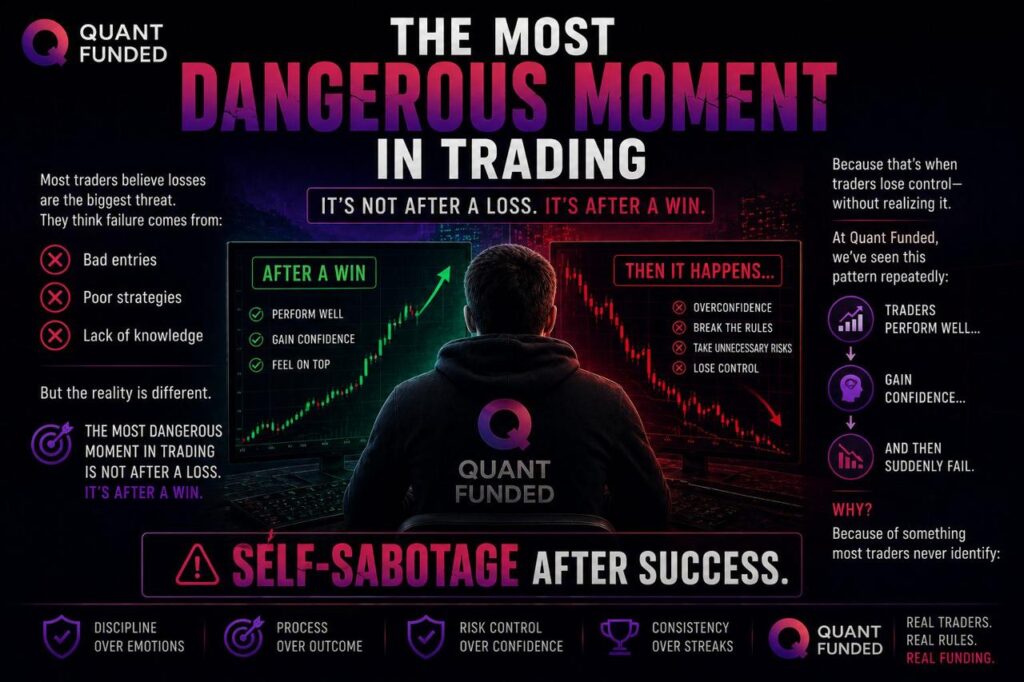
The Most Dangerous Moment in Trading
Why Success Can Be More Dangerous Than Failure
Most traders believe losses are the biggest threat to their trading performance.
They assume failure comes from poor entries, weak strategies, or a lack of market knowledge.
While those factors can certainly cause problems, the reality is often very different.
The most dangerous moment in trading is not after a loss.
It is after a win.
After a successful trade, many traders unknowingly lower their guard. Confidence rises, discipline weakens, and decisions become increasingly emotional. At first, it feels like momentum. In reality, it is often the beginning of self-sabotage.
At Quant Funded, we have seen this pattern repeatedly:
- Traders perform well.
- Confidence begins to grow.
- Rules become more flexible.
- Risk increases.
- Accounts fail.
The failure appears sudden, but the process usually starts long before the account violation occurs.
What Is Trading Self-Sabotage?
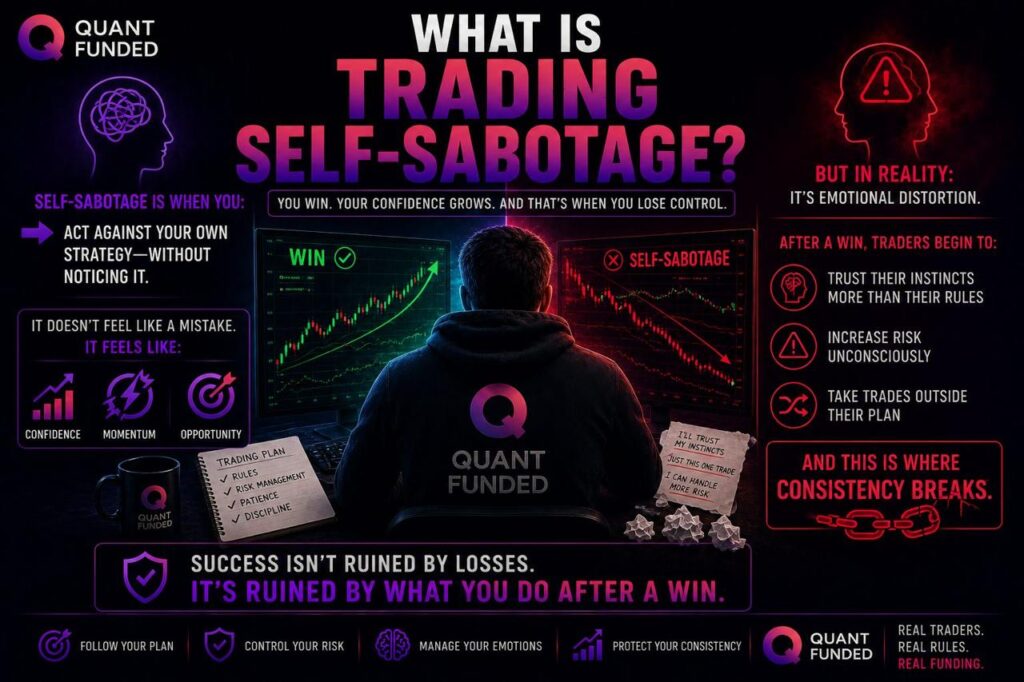
Trading self-sabotage occurs when a trader begins acting against their own strategy without realizing it.
The dangerous part is that it rarely feels like a mistake.
Instead, it feels like:
- Confidence
- Momentum
- Opportunity
- Conviction
However, beneath the surface, something else is happening.
The trader gradually starts trusting emotions more than rules.
Winning trades can cause traders to:
- Ignore confirmation signals
- Increase risk without proper justification
- Enter lower-quality setups
- Abandon established processes
This is often where consistency begins to break down.
Why Winning Trades Trigger Bad Decisions
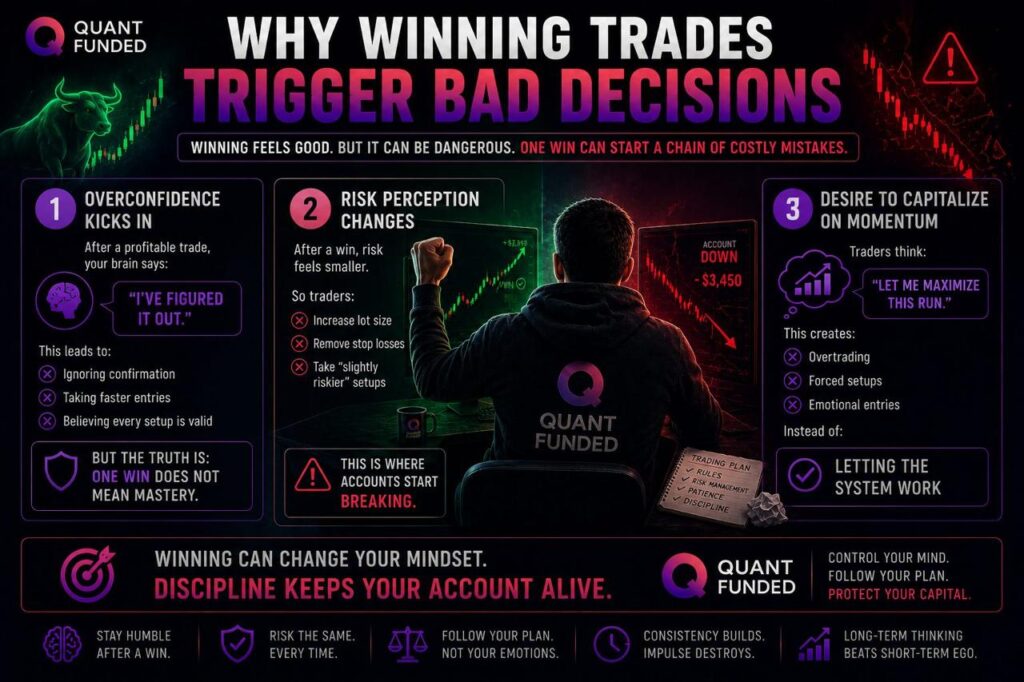
Winning creates powerful psychological shifts that can distort judgment.
1. Overconfidence Begins to Develop
After a profitable trade, many traders start believing they have fully figured out the market.
They begin entering trades more aggressively, skipping parts of their analysis, and assuming that future setups will perform just as well as the previous one.
The reality is simple:
One winning trade does not equal mastery.
Markets do not reward confidence. They reward consistency.
2. Risk Starts to Feel Smaller
One of the most dangerous effects of a winning streak is the change in perceived risk.
After a few successful trades, many traders unconsciously:
- Increase position sizes
- Widen stop losses
- Remove protective measures
- Accept lower-quality setups
Nothing has changed in the market.
Only the trader’s perception has changed.
Unfortunately, this is often where significant drawdowns begin.
3. The Desire to Maximize Momentum
Many traders experience the urge to capitalize on a winning streak.
They begin thinking:
“I need to maximize this run while it’s working.”
This mindset often leads to:
- Overtrading
- Forced entries
- Emotional decision-making
- Chasing opportunities
Instead of allowing the trading system to generate results naturally, the trader attempts to accelerate profits.
That acceleration frequently becomes the source of future losses.
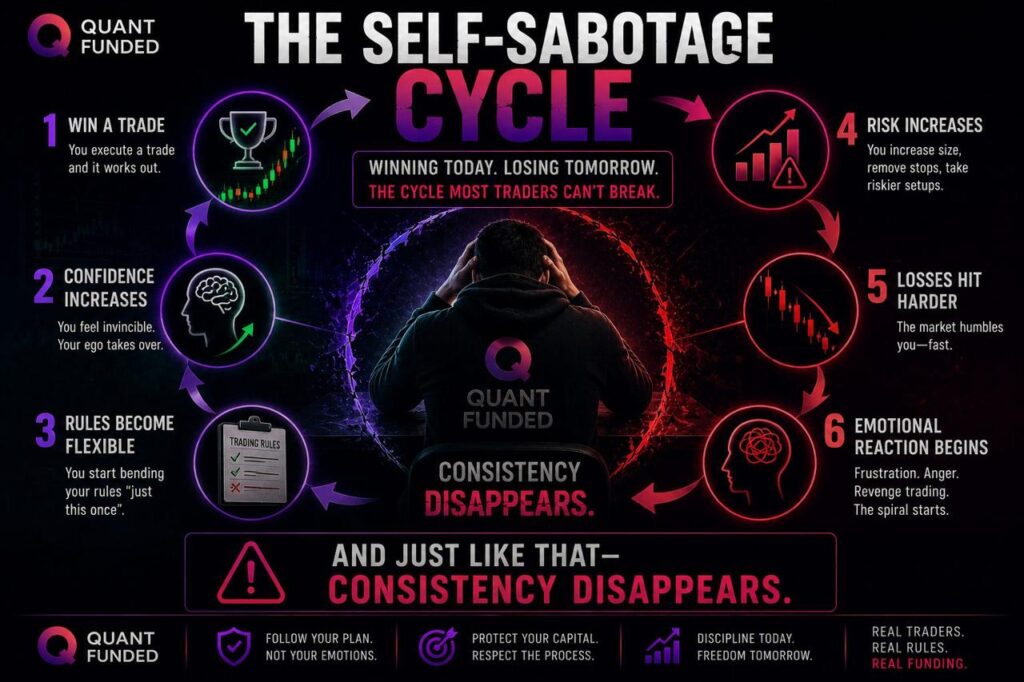
The Self-Sabotage Cycle
The cycle is surprisingly predictable.
A trader wins a trade.
Confidence rises.
Rules become slightly more flexible.
Risk begins to increase.
Losses become larger.
Emotions take over.
Consistency disappears.
In simple terms, the cycle looks like this:
Winning Trade → Increased Confidence → Flexible Rules → Higher Risk → Larger Losses → Emotional Reaction → Loss of Consistency
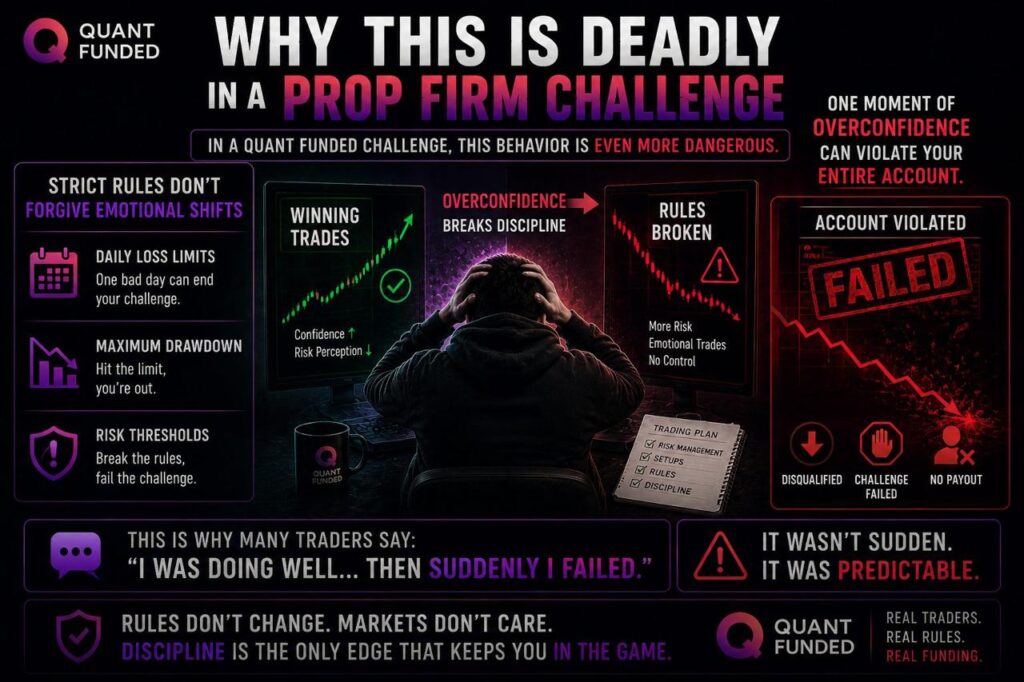
Many traders describe their challenge failures by saying:
“Everything was going well, and then suddenly I failed.”
In reality, it was rarely sudden.
The warning signs were present long before the account breach occurred.
Why This Is Especially Dangerous in a Prop Firm Challenge
Within a prop firm challenge, emotional mistakes are amplified.
Unlike personal trading accounts, funded challenges have strict risk parameters designed to protect capital and reward discipline.
These rules typically include:
- Daily loss limits
- Maximum drawdown restrictions
- Consistency requirements
- Risk management thresholds
A single emotional decision after a winning streak can be enough to violate the challenge.
This is why many traders lose accounts despite being profitable for extended periods.
The issue is often not the strategy.
The issue is the inability to remain disciplined after success.
The Professional Mindset After a Winning Trade
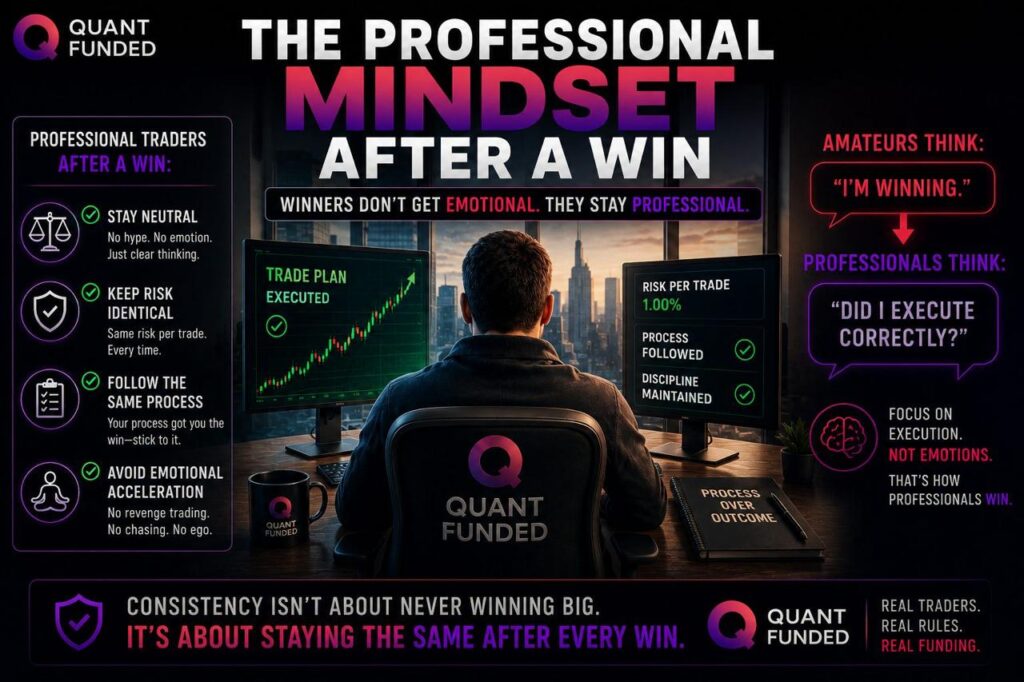
Professional traders view winning trades differently than most retail traders.
Instead of becoming emotionally attached to the result, they remain focused on the process.
After a winning trade, professionals:
- Maintain the same risk level
- Follow the same rules
- Continue evaluating setups objectively
- Avoid emotional acceleration
They do not think:
“I’m winning.”
They think:
“Did I execute my process correctly?”
That distinction is what separates long-term consistency from short-term performance.
How to Prevent Self-Sabotage
The good news is that self-sabotage can be managed through awareness and structure.
Here are several practical techniques traders can implement immediately.
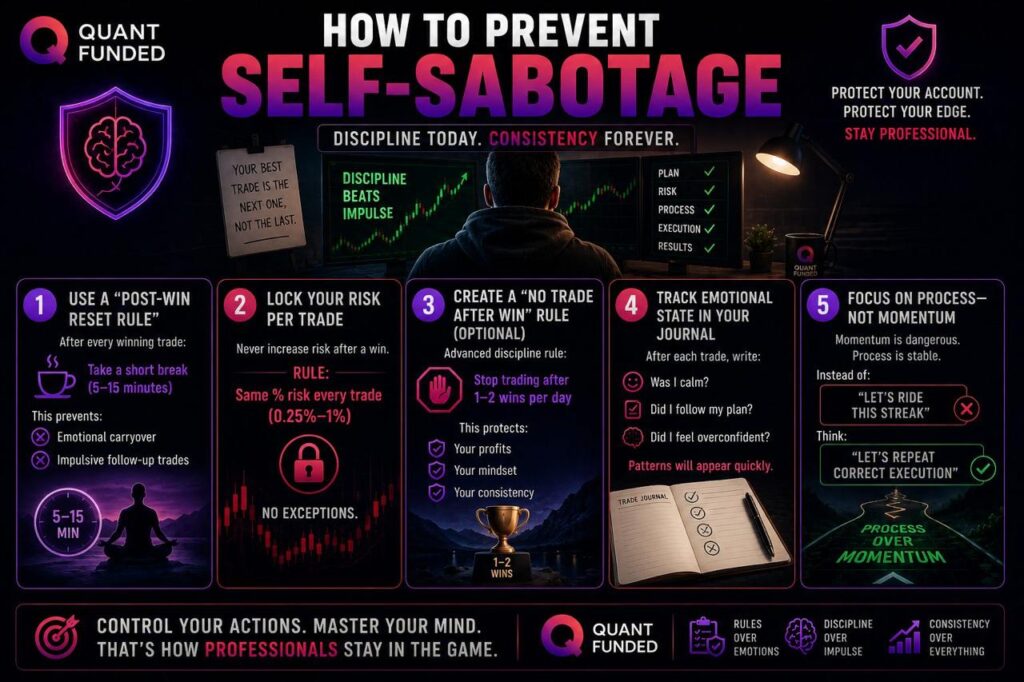
1. Create a Post-Win Reset Routine
After every winning trade, step away from the charts for five to fifteen minutes.
This short break allows emotions to settle and prevents the excitement of one trade from influencing the next.
A simple pause can dramatically improve decision quality.
2. Lock Your Risk Per Trade
One of the most effective rules in trading is maintaining identical risk across all setups.
Whether you win or lose, your risk should remain unchanged.
For most traders, this means risking between 0.25% and 1% per trade.
No exceptions.
Consistency in risk creates consistency in results.
3. Consider a Daily Win Limit
Some professional traders stop trading after reaching one or two successful trades for the day.
This approach may sound conservative, but it helps protect both profits and psychology.
A daily win limit can:
- Prevent overtrading
- Reduce emotional decisions
- Protect gains already achieved
Sometimes the best trade is no trade at all.
4. Journal Your Emotional State
Most trading journals focus on technical execution.
However, emotions should also be tracked.
After every trade, ask yourself:
- Was I calm?
- Did I follow my plan?
- Was I feeling impatient?
- Was I feeling overconfident?
Over time, patterns become obvious.
And once patterns become visible, they become easier to correct.
5. Focus on Process Rather Than Momentum
Momentum is temporary.
Process is sustainable.
Many traders think:
“Let’s ride the streak.”
Professional traders think:
“Let’s repeat quality execution.”
One mindset depends on emotions.
The other depends on discipline.
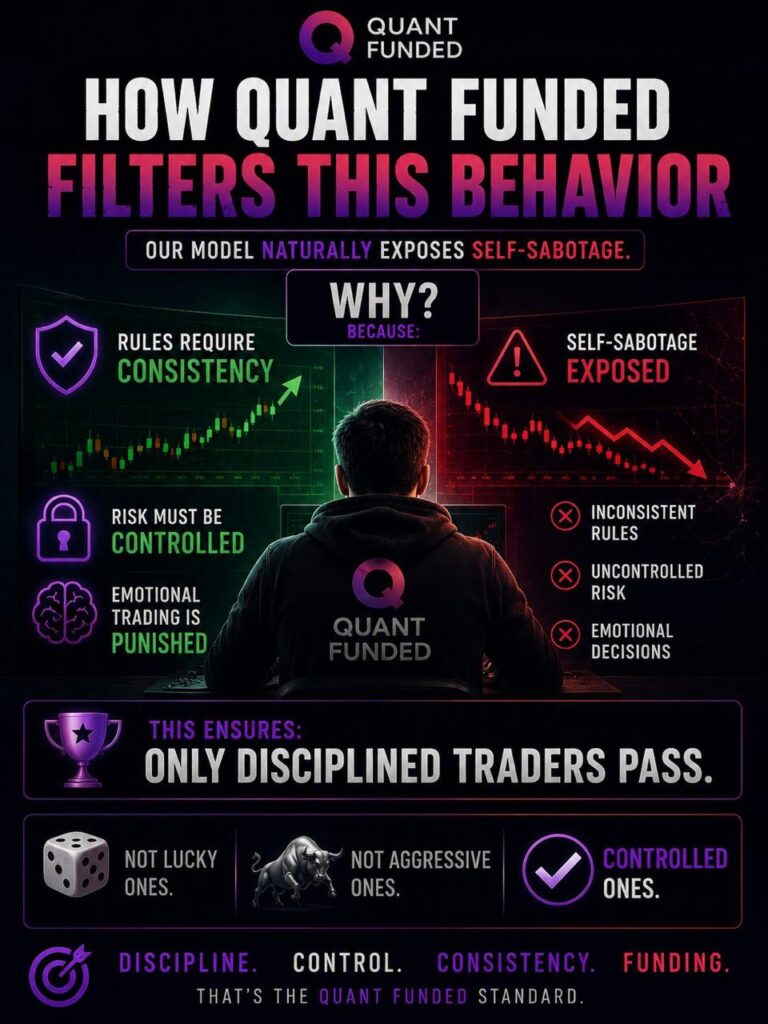
How Quant Funded Naturally Exposes This Behavior
At Quant Funded, challenge rules are designed to identify traders who can remain disciplined under pressure.
The evaluation process rewards:
- Consistency
- Risk control
- Professional execution
- Emotional stability
At the same time, it exposes behaviors such as:
- Overconfidence
- Excessive risk-taking
- Revenge trading
- Emotional decision-making
This helps separate disciplined traders from impulsive traders.
Success is not determined by who takes the biggest risks.
Success is determined by who manages risk most effectively.
The Real Insight Most Traders Miss
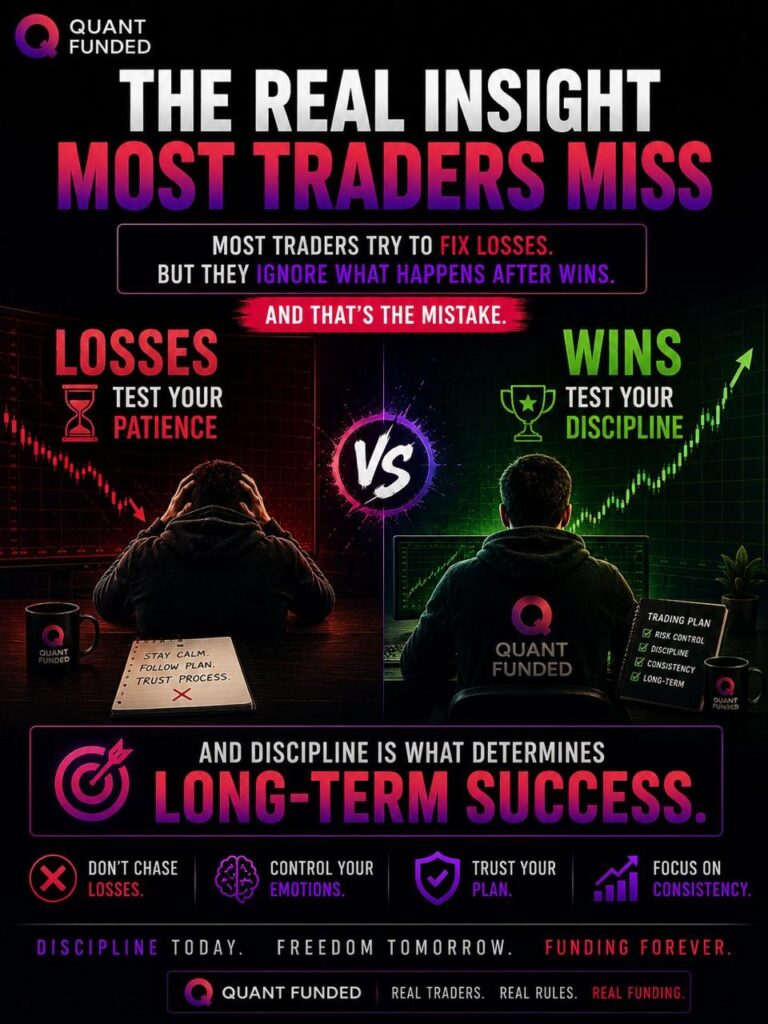
Most traders spend their time trying to fix what happens after a loss.
They study drawdowns.
They analyze mistakes.
They work on controlling frustration.
While all of these things matter, many overlook what happens after success.
And that can be an even bigger problem.
Because:
- Losses test your patience.
- Wins test your discipline.
The ability to stay disciplined after success is one of the strongest indicators of long-term trading performance.
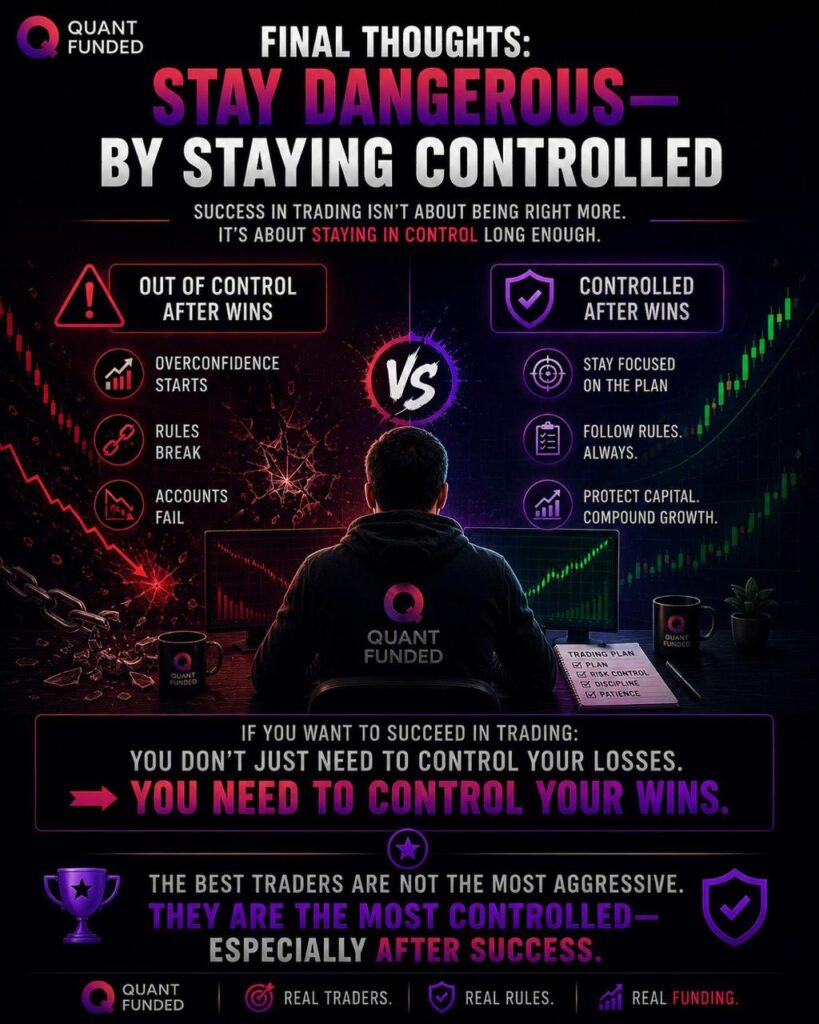
Final Thoughts: Stay Dangerous by Staying Controlled
If you want to become consistently profitable, you must learn to control more than your losses.
You must learn to control your wins.
Because winning trades often create the conditions that lead to future mistakes.
This is where:
- Overconfidence begins
- Rules become flexible
- Risk starts increasing
- Accounts ultimately fail
The most successful traders are not necessarily the smartest.
They are not always the most aggressive.
And they are not always the most talented.
What separates them is their ability to remain disciplined regardless of recent results.
They stay calm after losses.
They stay calm after wins.
And they understand a simple truth:
Long-term success is built through consistency, not emotion.
At Quant Funded, we believe sustainable performance comes from disciplined execution, controlled risk, and a professional mindset.
Because in trading, success is not defined by how much you win today.
It is defined by your ability to keep executing correctly tomorrow.
Control your losses.
Control your wins.
And let consistency do the work.